

Bali vs Chiang Mai for Digital Nomads: Which Hub Wins?
Disclaimer: This post may contain affiliate links, meaning we earn a small commission if you make a purchase through our links, at no additional cost to you. As an Amazon Associate, I earn from qualifying purchases.
Every remote worker who decides to pack a bag and head east eventually hits the exact same crossroads: bali vs chiang mai digital nomad life. As covered in our broader digital nomad Southeast Asia guide, these two destinations are the undisputed heavyweights of location-independent living. Both offer incredible food, thriving expat communities, and a cost of living that makes Western capitals look absurd.
Yet, once you actually land and open your laptop, the day-to-day reality of these two hubs could not be more different. Choosing the wrong one for your current work phase can either drain your bank account or stall your productivity. In this breakdown, we put Indonesia’s Island of the Gods head-to-head against Thailand’s northern mountain capital across cost, Wi-Fi, daily friction, and lifestyle.
📌 Key Takeaways (TL;DR)
- Cost of Living: Chiang Mai wins easily ($1,000–$1,300/month), while Bali’s lifestyle inflation pushes typical nomad budgets to $1,800–$2,500/month.
- Productivity vs. Lifestyle: Chiang Mai is built for deep focus, tech builders, and walkable convenience. Bali is built for surfing, networking, and tropical aesthetics.
- Daily Friction: Traffic congestion in southern Bali is severe. Chiang Mai is calm, organized, and easy to navigate without a scooter.
- Seasonality Hack: Stay in Chiang Mai from November to February to avoid the Burning Season, then fly to Bali from May to October for dry, sunny weather.
You’ll see…
Cost of Living: Budget vs. Lifestyle Inflation
On paper, both destinations are affordable. In practice, Chiang Mai is noticeably cheaper and much easier to budget for.
In Chiang Mai, you can rent a modern, fully furnished condo in the Nimman area with a pool and gym for $350 to $500 a month. Street food and local Thai restaurants serve generous, healthy meals for $2 to $3. A comfortable, high-output month rarely crosses $1,200.
Bali—specifically the nomad strongholds of Canggu, Uluwatu, and Ubud—suffers heavily from lifestyle inflation. While you can still find a basic guesthouse for $400 and eat at local warungs for $3, the island is engineered to make you spend. Boutique smoothie bowls, specialty coffee, beach club minimums, and private pool villas quickly push a standard monthly budget to $1,800–$2,500.
Internet, Coworking, and Productivity
If your job demands heavy bandwidth, constant Zoom calls, or deep-focus technical work, Chiang Mai takes the crown. Fiber-optic internet is standard across the city, and power outages are rare. Cafes are quiet, air-conditioned, and built for people who actually want to get eight hours of work done.
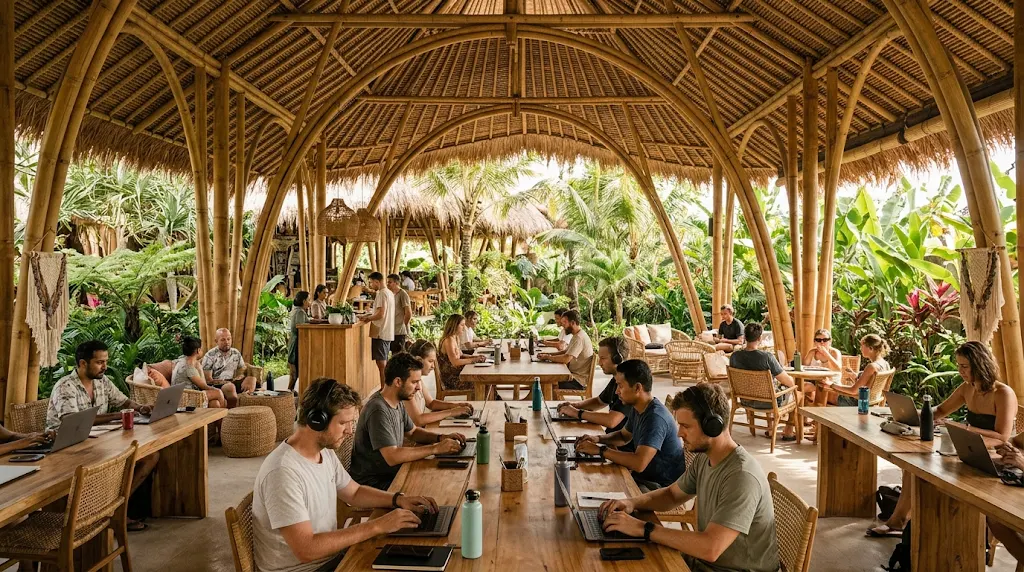
Bali’s internet has improved dramatically over the last few years, and its coworking spaces—like Dojo, Outpost, and Tropical Nomad—are some of the most aesthetically stunning offices on Earth. However, Bali is also famous for its “distraction tax.” Between surf sessions, sunset drinks, and open-air cafes with limited wall outlets, maintaining a strict 9-to-5 schedule takes serious discipline.

Vibe, Traffic, and Daily Life
This is where the bali vs chiang mai digital nomad debate becomes deeply personal.
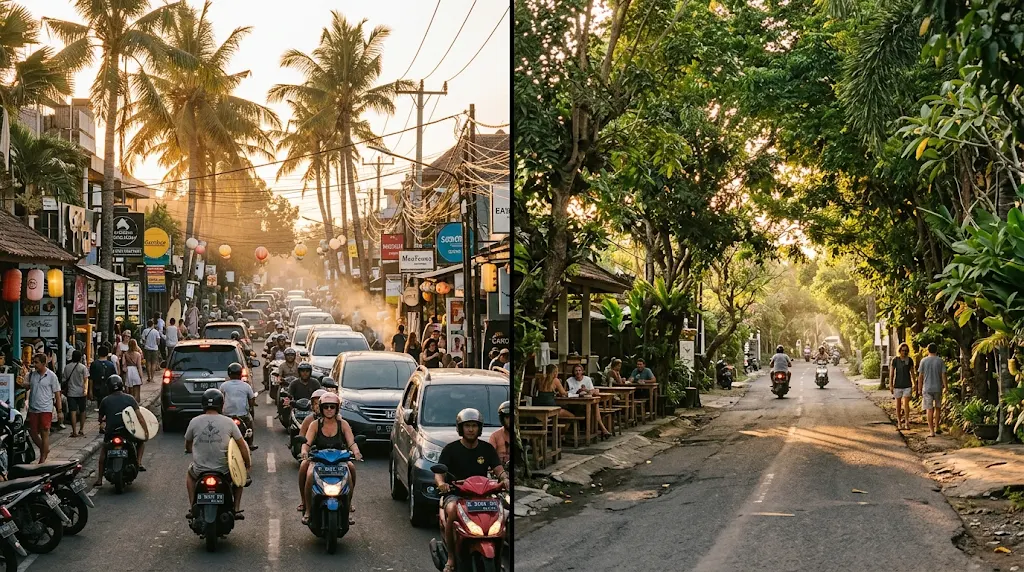
Chiang Mai is a calm, walkable, mountain-ringed city. As we detailed in our digital nomad in Chiang Mai guide, the crowd leans heavily toward developers, SEO specialists, e-commerce founders, and quiet builders. You can walk to your gym, grab a coffee, and be at your desk in ten minutes without ever touching a motorbike.
Bali is a tropical sensory overload. The crowd skews toward content creators, coaches, surfers, designers, and wellness entrepreneurs. The energy is electric and social, making it effortless to make friends. The downside? Traffic. Getting around Canggu or Seminyak on a scooter during peak hours means breathing exhaust fumes in gridlock, and the constant roar of motorbikes outside cafes makes good audio gear non-negotiable for client calls.

Seasonality: The Burning Season vs. The Rainy Season
Neither destination is a year-round paradise without caveats.
- Chiang Mai’s Dealbreaker: From late February to mid-April, agricultural burning traps thick smoke in the valley, creating hazardous air quality. Almost every long-term nomad leaves the city during these months.
- Bali’s Dealbreaker: From November to March, Bali enters its wet season. Expect heavy tropical downpours, high humidity, and occasional flooding on narrow scooter roads.
Because these seasons barely overlap, many experienced nomads split their year: spending November through January in Chiang Mai, and flying down to Bali from May through September when the island is dry and sunny.
The Verdict: Which One Should You Choose?
The right choice depends entirely on what you need out of the next three months.
Choose Chiang Mai if:
- You are in “monk mode” building a business, coding, or scaling a project.
- You want to maximize your savings and keep your monthly burn rate under $1,300.
- You hate sitting in traffic and prefer a walkable neighborhood with reliable air conditioning.
Choose Bali if:
- You want to surf before work, prioritize fitness/wellness, and live near the ocean.
- You thrive on high-energy networking, creative communities, and a vibrant social calendar.
- You are traveling with a family and looking into worldschooling—Bali (especially Ubud and Sanur) has an unmatched ecosystem of international hubs and green schools.
Logitech MX Anywhere 3S Wireless Mouse
Working on a laptop trackpad all day slows you down, and standard mice refuse to track on the glass tables and rough bamboo desks found in tropical cafes. The Logitech MX Anywhere 3S features an 8K DPI sensor that tracks smoothly on literally any surface—even clear glass. With ultra-quiet clicks, MagSpeed scrolling, and USB-C charging, it is the ultimate compact weapon for working from anywhere.
Check Current Price on AmazonFrequently Asked Questions
Is Bali or Chiang Mai cheaper for digital nomads?
Chiang Mai is significantly cheaper. A comfortable monthly budget in Chiang Mai sits around $1,000 to $1,300 USD, whereas a similar Western-style lifestyle in popular areas of Bali like Canggu or Ubud typically costs $1,800 to $2,500 USD per month.
Which has faster and more reliable Wi-Fi: Bali or Chiang Mai?
Chiang Mai has more consistent Wi-Fi. While Bali’s top coworking spaces offer fast fiber connections, residential villas and cafes in Bali still experience occasional dropouts and slower upload speeds compared to Chiang Mai’s urban fiber network.
Do I need a motorbike in Bali and Chiang Mai?
In Bali, a scooter is almost mandatory because neighborhoods are spread out and lack sidewalks. In Chiang Mai, you can easily live without one if you stay in Nimman or the Old City, relying on walking and cheap Grab rides.
When is the best time to visit both destinations?
Visit Chiang Mai between November and early February for cool, dry weather (avoiding the Burning Season in March–April). Visit Bali between May and October for sunny skies, low humidity, and the best surf conditions.