Minoan Civilization in Crete: Aegean Bronze Age Archaeology
Disclaimer: This post may contain affiliate links, meaning we earn a small commission if you make a purchase through our links, at no additional cost to you. As an Amazon Associate, I earn from qualifying purchases.
The Minoan civilization was a remarkable and highly advanced society that emerged on the island of Crete during the Bronze Age. Located strategically in the center of the eastern Mediterranean, ancient Crete became a powerhouse of trade, culture, and naval dominance. This vibrant civilization flourished for centuries and laid the foundational roots for ancient Greece and the broader Aegean region. Long before the classical era of Athens and Sparta, the Minoans were building sophisticated cities, creating breathtaking art, and navigating the vast seas.
Before the rise of the Greek mainland, the Minoans dominated the seas through what historians call a thalassocracy—a maritime empire. From early Minoan settlements that relied on basic agriculture to the pinnacle of the Neopalatial period with its monumental architecture, their maritime network reached Asia Minor, the Levant, Egypt, and possibly even the Black Sea. Let’s delve deeply into the history, myths, daily life, and archaeology of this incredible Bronze Age culture.
The Geography and Rise of Ancient Crete
To understand the Minoans, one must first understand their environment. Crete is the largest of the Greek islands, featuring a diverse landscape of towering mountains, fertile plains, and strategic natural harbors. This geography provided a unique evolutionary advantage. The mountains offered protection and resources like timber, which was crucial for shipbuilding, while the plains supported the cultivation of olives, grapes, and grains—the classic Mediterranean triad.
During the early Bronze Age, small agricultural communities across the island began to consolidate. Trade networks expanded, and local leaders started accumulating wealth. This surplus of resources led to a highly organized Minoan society, capable of undertaking massive public works. Unlike many ancient civilizations that were built along major river valleys, the Minoan culture was intrinsically tied to the sea. They were master shipbuilders and navigators, trading their prized olive oil, wine, and fine pottery for copper, ivory, and gold from foreign lands.
Minoan Palace of Knossos: The Heart of the Empire
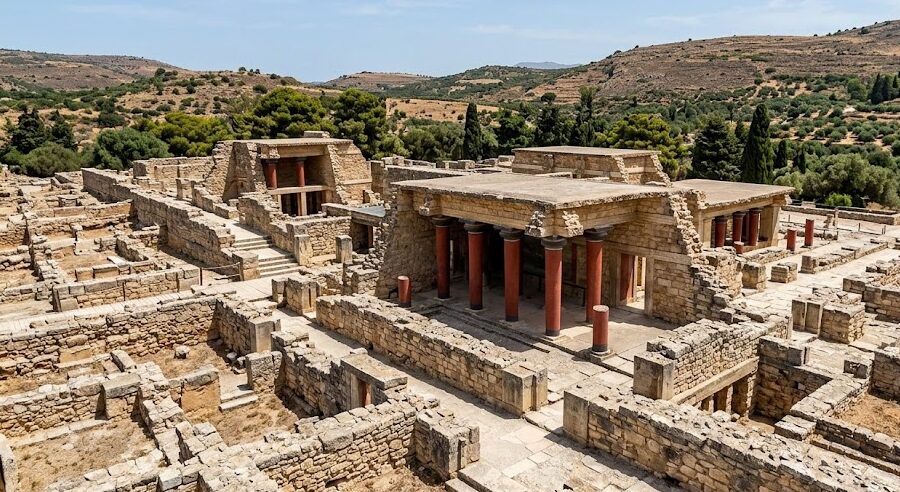
The absolute heart of Minoan Crete was the great Minoan palace of Knossos. Located near the modern city of Heraklion, this sprawling complex is the largest Bronze Age archaeological site on the island. According to Greek mythology, this massive settlement was the home of the legendary King Minos, the ruler who commissioned the architect Daedalus to build the Labyrinth to contain the monstrous Minotaur.
Archaeological evidence shows that these palace complexes were architectural marvels. They served as administrative, religious, economic, and political centers. Knossos was a labyrinthine structure itself, boasting over a thousand interlocking rooms, grand staircases, and open courtyards. Throughout the middle Minoan period, the art and architecture of the Minoans reached unprecedented heights. Remarkably, the palaces were completely unfortified. The absence of massive defensive walls suggests a peaceful society protected by an unassailable navy and natural geographic isolation.
Walking through these Minoan sites today, visitors can observe complex drainage systems and the remnants of intricate multi-story buildings that characterized the Minoan capital. They utilized advanced plumbing, including terracotta pipes that supplied clean water and carried away waste, a technological feat that would not be seen again in Europe for centuries.
Other Major Minoan Sites: Phaistos, Malia, and Zakros
While Knossos is the most famous, it was not the only center of power. The island was dotted with several major palace complexes, each controlling its surrounding agricultural territory. Phaistos, located in the fertile Mesara Plain in the south, is the second-largest palace. It is renowned for its majestic grand staircase and its stunning views, but it is perhaps best known as the discovery site of the Phaistos Disc, a mysterious clay disk stamped with an undeciphered spiral of symbols.
Malia, situated on the northern coast, provides a clearer picture of town planning during the Minoan period, complete with extensive workshops and a bustling central court. Meanwhile, Kato Zakros, located on the far eastern edge of the island, served as the primary gateway for trade with the Middle East and Egypt. These regional centers were connected by a network of paved roads, highlighting the highly organized administrative nature of the Minoan civilization.
Bull Leaping Fresco: Features of Minoan Civilization
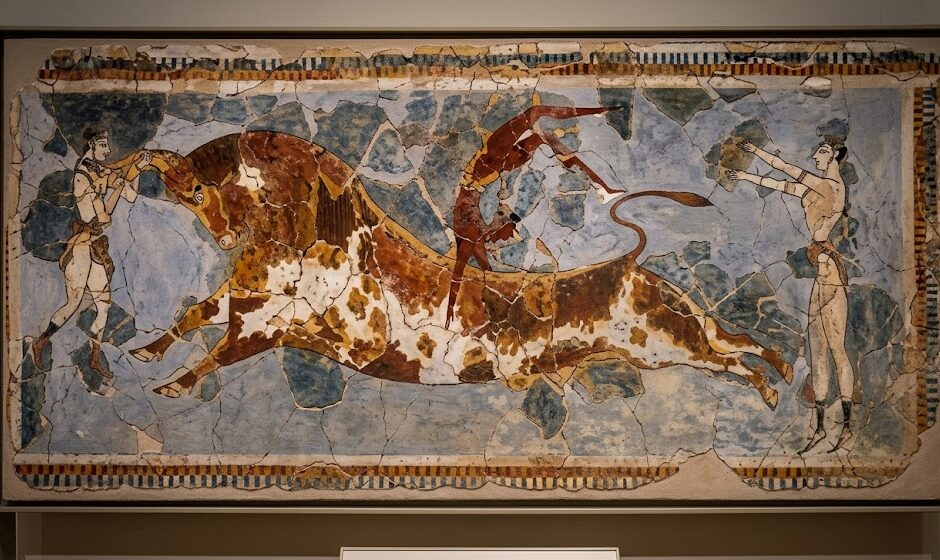
One of the most famous and enigmatic features of Minoan culture is the sport of bull leaping. Depicted vividly in a stunning Minoan fresco found at Knossos, this highly dangerous acrobatic feat involved skilled athletes grasping the horns of a charging bull and vaulting gracefully over its back. It is widely considered one of the oldest athletic rituals in ancient Greece, blending extreme physical prowess with deep religious significance.
Unlike the later Mycenaean civilization which focused heavily on warfare, hunting, and martial themes, Minoan religion and public spectacles centered around nature, animals, and the revered bull. The bull was a symbol of power and fertility, and its imagery, known as the “horns of consecration,” can be found decorating palace roofs and shrines across the island. The intricate pottery and colorful frescoes provide a vivid window into how the Minoans celebrated life, agility, and their deep connection to the natural world.
Religion, Society, and the Snake Goddess
The religious practices of the Minoans remain a fascinating subject for historians. Unlike the patriarchal pantheon of classical Greece, Minoan religion appeared to be heavily matriarchal, focusing on a supreme nature goddess. The famous faience figurines of the “Snake Goddess,” discovered at Knossos, depict a powerful female figure holding serpents in her hands, symbolizing her dominion over the earth and the underworld.
Rituals were not confined to the grand palaces. The Minoans worshipped in sacred caves and built “peak sanctuaries” on the tops of mountains, where they offered terracotta figurines and libations to their deities. It is believed that women, particularly priestesses, held a highly elevated status in Minoan society, playing central roles in religious ceremonies, administration, and public life. They also placed great importance on the afterlife, burying their dead in elaborate circular tholos tombs and placing everyday objects within the bone chambers outside to accompany the deceased.
Arthur Evans and the Archaeology of Minoan Sites
Our modern understanding of the Minoan civilization is heavily owed to the British archaeologist Sir Arthur Evans. Beginning his pioneering work in 1900, Evans set out to excavate Knossos. Driven by the myths of King Minos and the Minotaur, he unearthed the grand Minoan palace and officially coined the term “Minoan” to describe this lost culture. Today, archaeology online databases and prominent global history museums are filled with his groundbreaking discoveries.
Evans was meticulous but also controversial. He undertook massive reconstruction efforts at Knossos, repainting columns and restoring walls using modern concrete to give visitors a sense of the palace’s former glory—a practice that modern archaeologists debate. Nevertheless, his contributions were monumental.
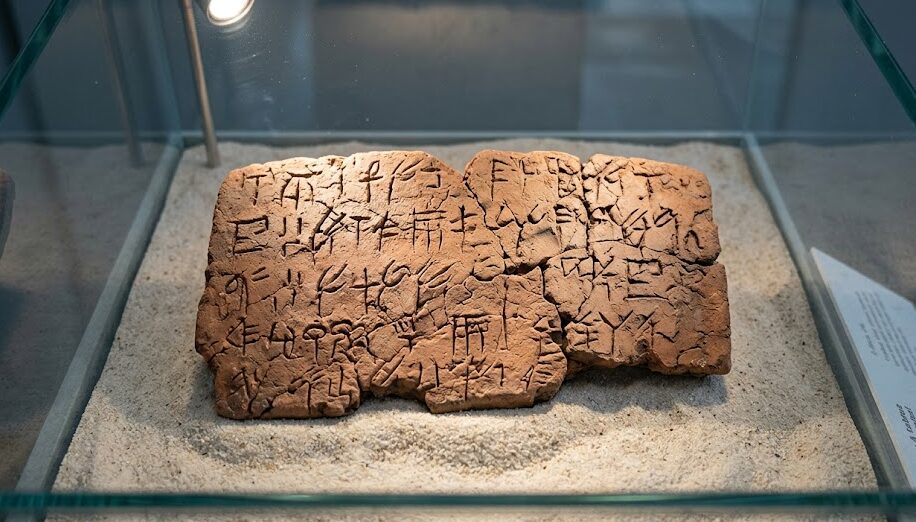
During his excavations, Evans discovered thousands of clay tablets containing the administrative language of the Minoans. The older script, known as Linear A, has yet to be deciphered, keeping much of the early Minoan period a mystery. This script was used primarily for accounting, tracking agricultural yields, and managing the palace economies. However, the later script, Linear B, was deciphered in the 1950s and was recognized as an early form of Greek, adapted by the Mycenaeans who later occupied the island.
Santorini Eruption and the End of the Minoan Civilization
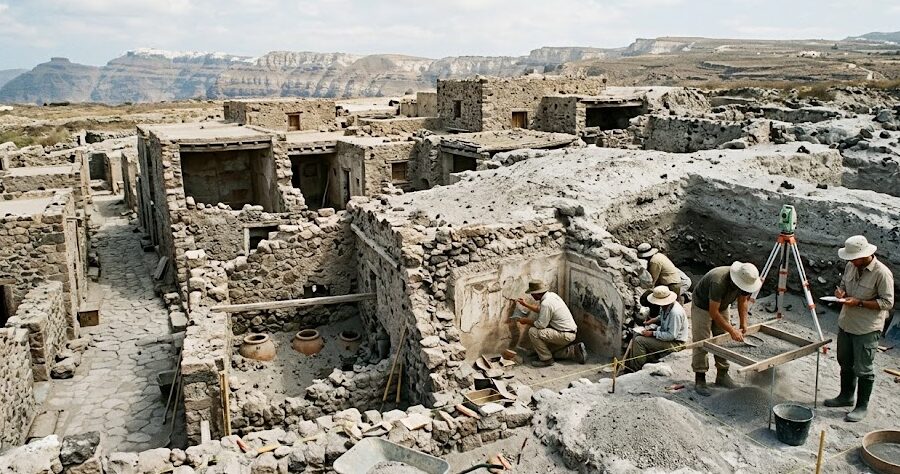
The demise of the Minoan civilization is one of the greatest mysteries of the ancient world. Around the middle of the 15th century BCE, a catastrophic volcanic eruption occurred on the nearby island of Thera (modern Santorini). The Minoan eruption was one of the largest in recorded human history. It literally blew the center out of the island, burying the advanced Minoan settlement of Akrotiri under meters of volcanic ash.
This eruption triggered massive tsunamis that struck the northern coast of Crete, destroying the Minoan naval fleet and coastal infrastructure. Accompanying earthquakes devastated the palace complexes. Furthermore, the volcanic ash cloud likely plunged the eastern Mediterranean into a localized “volcanic winter,” causing widespread crop failures and famine.
While the Minoan civilization continued to flourish briefly after the disaster, the ensuing changes in Minoan society and their severely weakened infrastructure left them vulnerable. Eventually, the aggressive, warlike Mycenaean culture from the Greek mainland seized the opportunity to invade. By the late Minoan period, Knossos itself was destroyed and rebuilt under Mycenaean control. Major Minoan sites were abandoned or repurposed, and the Mycenaeans completely assimilated the remnants of the Cretan people.
The Enduring Legacy of Ancient Crete
The fall of the Minoans paved the way for the rise of the Mycenaeans, who eventually gave birth to the classical Greek civilization we know today. Yet, the legacy of the Minoans lived on in Greek mythology, embedded in the stories of the Labyrinth, the Minotaur, and the seafaring prowess of King Minos. Today, the ongoing archaeological excavations continue to reveal new secrets about Europe’s first great civilization, ensuring that the remarkable achievements of the Minoans will never be forgotten.
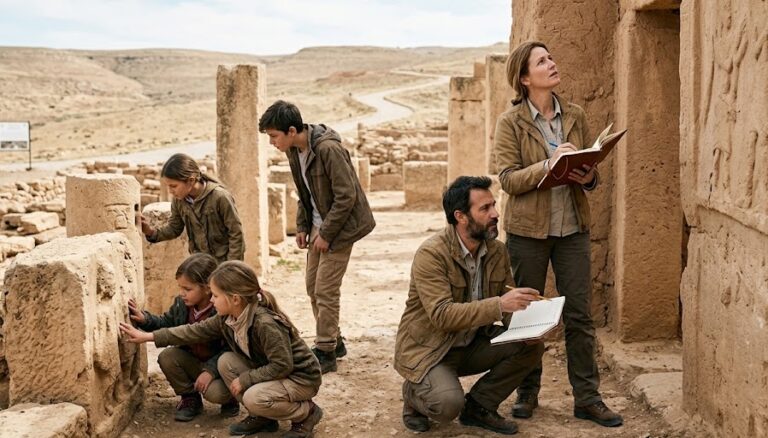
*Editorial Note: The visual representations of historical sites and artifacts in this article are AI-assisted reconstructions. They are designed for educational purposes to help readers visualize these magnificent ancient sites based on current archaeological data.